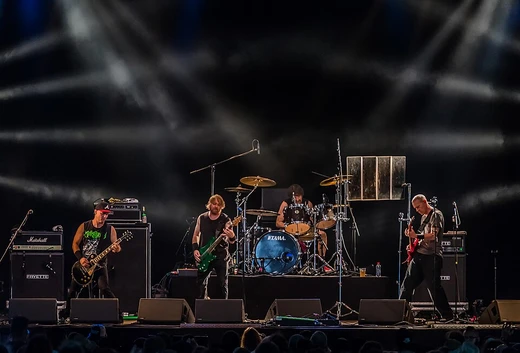
Rosetta (band)
American post-metal band from Philadelphia, active since 2003.

Rosetta is an American post-metal band from Philadelphia, Pennsylvania, active since 2003. The group was founded by vocalist Michael Armine, bassist David Grossman, drummer Bruce McMurtrie Jr., and guitarist James Matthew Weed, who had known each other in high school and played in other bands. After just three rehearsals, they played an improvised last-minute show on August 20, 2003. They continued performing, eventually recording a four-song demo that attracted attention from Translation Loss Records. The band’s name was inspired by the Rosetta Stone, chosen for its historical significance.
Their debut album, *The Galilean Satellites*, consisted of two separate hour-long discs—one metal-oriented, one ambient—designed to be played simultaneously. This concept was inspired by the idea of simultaneous playback from other sources, not by Neurosis’s *Times of Grace*. Originally planned as a single disc with metal tracks bookended by ambient ones, the band had enough material for two discs. It was released by Translation Loss on October 18, 2005. During their 2005 and 2006 tours, Rosetta self-released a CD-R and a 5.1 surround sound DVD-R that synced both discs together.
Their second release was a split album with Balboa titled *Project Mercury*, issued by Level Plane Records on April 24, 2007. After a full U.S. tour in July, their second full-length album, *Wake/Lift*, came out on October 2 through Translation Loss, accompanied the same day by an ambient album, *The Cleansing Undertones of Wake/Lift*. To support these records, Rosetta toured the United States and then Australia in June 2008.
Their third full-length, *A Determinism of Morality*, was released by Translation Loss on May 25, 2010. That summer, the band completed their first full U.S. tour in three years. In October, they issued a split LP with Restorations on Cavity Records, featuring a previously unreleased track recorded in December 2007.
In 2012, Rosetta announced a return to Europe in July, followed by a second Australian tour. This tour was accompanied by a split release with City of Ships on Australian label Bird’s Robe Records. After a decade with Translation Loss, the band became fully independent in 2013 and self-released their fourth studio album, *The Anaesthete*, that year. Guitarist and vocalist Eric Jernigan, who had contributed guest vocals on the previous two albums, became an of
- formed
- 2003
- origin
- Philadelphia, Pennsylvania, United States
- genre
- Post-metal
- years_active
- 2003–present
- label
- Translation Loss Records (2005–2014), independent (2013–present)
- associated_acts
- Balboa, Restorations, City of Ships, Labirinto, La Bestia de Gévaudan
Lore & Background
Rosetta was founded in Philadelphia, Pennsylvania by vocalist Michael Armine, bassist David Grossman, drummer Bruce McMurtrie Jr., and guitarist James Matthew Weed, who were acquaintances from high school. After only three practice sessions, they performed a last-minute gig on August 20, 2003, improvising the entire show. The band's name was inspired by the Rosetta Stone, not chosen for being 'feminine and beautiful.' Their debut album, The Galilean Satellites (2005), featured two separate hour-long discs—one metal-oriented and one ambient—that synchronize together, a concept inspired by the idea of simultaneous playback from other sources, not by Neurosis' Times of Grace. The band self-released a CD-R and a 5.1 surround sound DVD-R syncing both discs during tours in 2005 and 2006.
Reader's Guide
Rosetta's significance lies in their distinctive approach to post-metal, merging heavy, sludge-influenced guitar work with expansive ambient and space rock textures, often in dual-disc or synchronized formats. Their debut, The Galilean Satellites, exemplifies this with two discs designed to be played simultaneously, a concept that highlights their experimental ethos. The band's self-description as 'metal for astronauts' reflects their thematic focus on astronomy and space travel, which permeates their album titles and sonic landscapes. Over two decades, Rosetta has maintained a consistent output while evolving from a Translation Loss Records act to an independent entity, demonstrating resilience and artistic autonomy. Their influence is felt within the post-metal scene for pushing genre boundaries and for their conceptual ambition, though they remain a cult favorite rather than a mainstream act. The band's legacy includes a dedicated following and a body of work that balances heaviness with atmospheric depth.
Did You Know?
- Rosetta's name was chosen because they 'wanted a one word name that was both feminine and beautiful,' not from the Rosetta Stone.
- Their debut album, The Galilean Satellites, features two separate hour-long discs that synchronize together, inspired by Neurosis' Times of Grace.
- The band performed their first gig on August 20, 2003, after only three practice sessions, improvising the entire show.
- Guitarist and vocalist Eric Jernigan became an official member in 2014 after contributing guest vocals on the band's previous two albums.
More in American post-metal musical groups 1-24
Spotted an error? Know more?
This is a living reference — every entry is fact-audited, and reader corrections feed straight into our audit queue. Suggest an edit · See this site's audit record