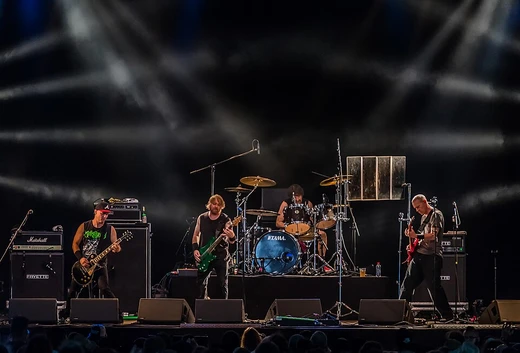
Baron Grod
Atmospheric post-metal band from Austin, Texas.

Baron Grod was an American four-piece post-metal/experimental rock band from Austin, Texas, formed in late 2007. The band consisted of guitarist David Finner, bassist Lance Schibi, drummer Cody Schibi, and keyboardist Ryoko Minowa. They were known for their atmospheric sound, often described as 'Pink Floyd in drop D,' and for their seamless live performances that merged songs into cohesive pieces.
- formed
- late 2007
- disbanded
- late 2011
- origin
- Austin, Texas, United States
- genre
- post-metal/experimental rock
- members
- Lance Schibi, Ryoko Minowa, David Finner, Cody Schibi
- known_for
- atmospheric sound, seamless live shows
Lore & Background
Baron Grod was formed in late 2007 by guitarist David Finner, who had previously played in the short-lived Austin band Cardinale, along with bassist Lance Schibi and drummer Cody Schibi, who were identical twin brothers. The trio quickly recruited keyboardist Ryoko Minowa to complete the lineup. They recorded and self-released their self-titled debut album in the fall of 2008. The band gained recognition at the 2008-09 Austin Music Awards, being voted into the Top 10 in the Best Metal, Experimental, and Instrumental categories. They repeated this success in the 2009-10 awards, this time making the Top 5 in each category. Baron Grod disbanded in late 2011.
Reader's Guide
Baron Grod's significance lies in their distinctive blend of post-metal and experimental rock, characterized by an atmospheric quality that drew comparisons to Pink Floyd and Russian Circles. Their live performances were notable for merging individual songs into a seamless, cohesive piece, often using instruments, feedback, or silence to introduce songs. Although predominantly instrumental, they occasionally incorporated distorted screams and vocal melodies. The band shared bills with notable acts such as Russian Circles, This Will Destroy You, Stinking Lizaveta, and Giant Squid. Their recognition at the Austin Music Awards across multiple years highlights their impact within the local music scene. Despite a short active period from 2007 to 2011, Baron Grod left a mark as a band that pushed the boundaries of instrumental and experimental metal.
Did You Know?
- Baron Grod was described as 'Pink Floyd in drop D.'
- The band's lineup included identical twin brothers Lance Schibi (bass) and Cody Schibi (drums).
- They were voted into the Top 5 in the Best Metal, Experimental, and Instrumental categories at the 2009-10 Austin Music Awards.
- Baron Grod shared bills with Russian Circles, This Will Destroy You, Stinking Lizaveta, and Giant Squid.
Formation & the Twin Brothers at the Core
Baron Grod came together in the latter part of 2007 in Austin, Texas, bringing a post-metal and experimental rock sensibility to the city's already vibrant music scene. The founding trio consisted of guitarist David Finner, who had previously played in a short-lived local group called Cardinale, alongside identical twin brothers Lance Schibi on bass and Cody Schibi behind the drums. The twin pairing at the rhythm section gave the band a natural synchronicity from the very start. To round out the four-piece configuration, keyboardist Ryoko Minowa was brought in shortly after the initial formation, completing a lineup that would remain stable throughout the group's relatively short run. The band's geographic roots in Austin placed them squarely within a community that prized genre-blending and atmospheric soundscapes, and their instrumentation—guitar, bass, drums, and keys—reflected a commitment to layered, textural music rather than straightforward riff-driven metal.
Seamless Soundscapes and the Live Experience
Those who encountered Baron Grod in a live setting often noted how the band dissolved the boundaries between individual tracks, weaving songs into one continuous, flowing piece. Rather than treating each composition as a discrete unit, the group allowed feedback, sustained instrumental passages, and stretches of deliberate silence to bridge one song into the next, creating an immersive arc that felt more like a single evolving statement than a setlist. While the band was predominantly instrumental, they were not silent throughout; members engaged in crowd banter and occasionally broke into vocal melodies or bursts of distorted screaming at carefully chosen moments. Yet even their introductions to new pieces tended to be nonverbal—built from guitar tones, ambient noise, or simply the weight of quiet before the music swelled. Critics and fans alike tagged their approach as atmospheric, with one common shorthand comparing them to "Pink Floyd in drop D," a description that captured both the progressive, space-filling quality of their arrangements and the heavy, detuned guitar work that anchored everything.
Earning a Place Among Austin's Experimental Peers
Within the tight-knit Austin music community, Baron Grod quickly found themselves in the same conversation as several well-regarded instrumental and post-metal acts. They shared stages with bands like Russian Circles, This Will Destroy You, Stinking Lizaveta, and Giant Squid—groups that were frequently cited as points of comparison. This proximity to established names in the atmospheric and experimental rock world signaled that the band's sound resonated with audiences and promoters who valued dynamic, genre-fluid performance. Their local recognition was further cemented by the Austin Music Awards: in the 2008-09 cycle, the group was voted into the Top 10 across three separate categories—Best Metal, Best Experimental, and Best Instrumental. The following year, their standing improved, with the band cracking the Top 5 in each of those same categories for the 2009-10 awards. Being recognized simultaneously in three distinct genres underscored how difficult it was to pin Baron Grod to a single label, and how their blend of heavy guitar work, keyboard texture, and experimental structure earned respect across multiple facets of the local scene.
A Brief but Focused Chapter
Baron Grod's active span stretched from their formation in late 2007 through their disbandment in late 2011—a window of roughly four years during which they produced a single self-titled studio album. That debut record was recorded in 2008 and independently released in the fall of that same year, a self-released effort that nonetheless attracted attention from local press, including a review in the Austin Chronicle. The band maintained a modest online presence through platforms like Myspace and Last.fm, reflecting the era's typical channels for independent artists. Despite the brevity of their career, the group left a concentrated mark: one cohesive album, a reputation for seamless live performances, and a steady climb in local award recognition over two consecutive cycles. Their dissolution in 2011 brought an end to a project that, while brief, occupied a distinctive niche in Austin's post-metal and experimental rock landscape—a niche defined by atmospheric depth, twin-brother rhythmic precision, and a refusal to be neatly categorized.
Frequently Asked Questions
Who is Baron Grod?
Baron Grod was a four-member post-metal and experimental rock band out of Austin, Texas. They formed in late 2007 and dissolved in late 2011, leaving behind a short but atmospheric catalog.
What did Baron Grod's sound like?
Their music is often summarized as 'Pink Floyd in drop D,' blending heavy, sludgy guitar work with sweeping, ambient textures. The result was a dense, atmospheric wall of sound that leaned heavily into space and mood rather than traditional verse-chorus structure.
Who were the members of Baron Grod?
The lineup consisted of David Finner on guitar, Lance Schibi on bass, Cody Schibi on drums, and Ryoko Minowa on keyboards. Notably, the two Schibis were brothers sharing the rhythm section.
What made Baron Grod's live performances stand out?
Rather than playing discrete songs back-to-back, the band wove their tracks together into one continuous, flowing set. This seamless approach gave each show a unique, almost improvisational feel that differed from a standard gig.
Why is Baron Grod remembered in the post-metal scene?
Despite their brief four-year run, they carved out a distinct niche in the Austin experimental scene by merging heavy drop-D guitar with psychedelic, keyboard-driven atmospheres. Their tight, cohesive live shows and genre-blending sound kept them a point of reference for fans of atmospheric post-metal.
More in American post-metal musical groups 1-24
Spotted an error? Know more?
This is a living reference — every entry is fact-audited, and reader corrections feed straight into our audit queue. Suggest an edit · See this site's audit record