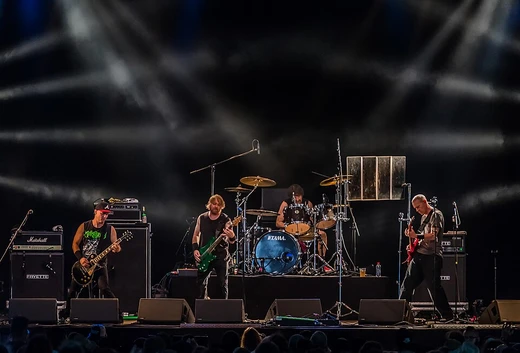
Isis (band)
Boston post-metal pioneers who evolved from hardcore roots to atmospheric heaviness

Isis (often written as ISIS) was an American post-metal band formed in Boston, Massachusetts, in 1997, remaining active until 2010. The group’s core lineup—vocalist and guitarist Aaron Turner, bassist Jeff Caxide, drummer Aaron Harris, guitarist Michael Gallagher, and keyboardist Bryant Clifford Meyer—stabilized after their debut album, but earlier years saw changes: Chris Mereschuk left after 1998, Jay Randall was briefly a member in 1999, and Meyer replaced Randall after *Celestial* was recorded.
Drawing from hardcore punk and doom metal, Isis both borrowed from and helped shape the post-metal style first developed by acts like Neurosis and Godflesh. Their music featured long songs built on repetition and evolving structures. Their debut album *Celestial* and early EPs were released on Escape Artist Records and Second Nature Recordings, with Ipecac Recordings handling releases from *Oceanic* onward. The band broke up in June 2010, just before a split EP with the Melvins came out, and reunited only once in 2018 under the name Celestial for a single show honoring Caleb Scofield, the late bassist and vocalist of Cave In.
Critics regard Isis as influential pioneers of post-metal. Their album *Oceanic* was named one of the best albums of 2002 by Pitchfork and one of the greatest metal albums of all time by Rolling Stone.
The band began in autumn 1997 in Boston, when friends Aaron Turner, Jeff Caxide, Chris Mereschuk (electronics and vocals), and Aaron Harris started experimenting together. Turner later explained that the group formed because none of the founding members were satisfied with their previous musical projects; two of them lived together and shared similar tastes and record collections. Isis played their first shows in Boston in spring 1998 and soon recorded a demo at Salad Days Studios. After an East Coast tour that summer with guitarist Randy Larsen of Cable, Mereschuk left. In 1999, Michael Gallagher and Jay Randall joined, contributing to the *Red Sea* release. Randall’s time with the band was short, and he was replaced by guitarist and keyboardist Bryant Clifford Meyer. Following their debut full-length *Celestial* (2000) and its companion EP *SGNL›05* (2001, on Neurot Recordings), Isis gained national underground attention in the metal and hardcore scene through tours with Cave In and Neurosis. This lineup remained unchanged until the band’s
- born
- 1997
- died
- 2010
- field
- Post-metal
- nationality
- American
- known_for
- Pioneering post-metal; albums Oceanic and Panopticon
Lore & Background
Isis formed in Boston in autumn 1997 from sessions among friends Aaron Turner, Jeff Caxide, Chris Mereschuk, and Aaron Harris. After an East Coast tour in summer 1998, Mereschuk left. Michael Gallagher and Jay Randall joined in 1999, but Randall's tenure was brief, and Bryant Clifford Meyer replaced him after *Celestial* was recorded. The band released their debut full-length *Celestial* in 2000 on Escape Artist Records and the EP *SGNL›05* in 2001 on Neurot Recordings, gaining underground attention through tours with Cave In and Neurosis. They signed with Ipecac Recordings after Mike Patton became a fan, and Ipecac released all albums from *Oceanic* onward.
*Oceanic* (2002) marked a turning point, incorporating post-rock and ambient elements and helping define post-metal. It received album-of-the-year accolades from *Rock Sound* and *Terrorizer*. *Panopticon* (2004) furthered this progression, reaching No. 47 on Billboard's Top Independent Albums. *In the Absence of Truth* (2006) was their most commercially successful release, peaking at No. 8 on the Top Heatseekers chart. Their final show was in Montreal on June 19, 2010, while their first show was in Boston in spring 1998.
Reader's Guide
Isis is widely regarded as an influential pioneer in the post-metal genre. Their 2002 album Oceanic was named one of the best albums of 2002 by Pitchfork and one of the best metal albums of all time by Rolling Stone. The band's sound, built on lengthy songs with repetition and structural evolution, influenced contemporaries such as Cult of Luna, Pelican, Tides, Rosetta, and Russian Circles. Their work attracted attention from artists like Mogwai and Justin Broadrick, who remixed their material. Isis's albums consistently evolved, incorporating post-rock, ambient, and electronic elements while maintaining metallic intensity. The band's commercial success grew steadily, with Wavering Radiant becoming their first album to enter the Billboard 200. Despite their influence, the band members remained uncomfortable with fame, as Turner noted. Their dissolution in 2010 marked the end of a thirteen-year run that helped shape the post-metal landscape.
Did You Know?
- Isis disbanded in June 2010 just before the release of a split EP with the Melvins.
- The band reformed only once in 2018 as Celestial for a one-off show to pay tribute to the late Cave In bassist-vocalist Caleb Scofield.
- Oceanic was named one of the best albums of 2002 by Pitchfork and one of the best metal albums of all time by Rolling Stone.
- Isis's final show was in Montreal, the location of the band's very first show.
Frequently Asked Questions
Who is Isis (band)?
Isis was an American post-metal outfit formed in Boston, Massachusetts, in 1997 and active until their 2010 breakup. Their stable core lineup featured vocalist/guitarist Aaron Turner, bassist Jeff Caxide, drummer Aaron Harris, guitarist Michael Gallagher, and keyboardist Bryant Clifford Meyer.
What are Isis's most famous albums?
Fans most frequently cite *Oceanic* (2006) and *Panopticon* (2009) as the band's defining records. Both are regarded as landmarks of atmospheric, heavy post-metal and remain central to the genre's canon.
What genre does Isis belong to and where did their sound come from?
Isis is classified as a post-metal band, blending the aggression of hardcore punk with the weight of doom metal. Over time they shifted toward slower, more atmospheric compositions while retaining that foundational heaviness.
How did Isis come to an end?
The band called it quits in 2010 after roughly thirteen years of activity. Their final period saw Aaron Turner move into solo and side-project work, marking the close of the group's run.
Why is Isis considered important in post-metal?
Isis is widely credited with helping pioneer the post-metal sound, bridging the gap between raw hardcore energy and expansive, atmospheric heaviness. Their influence can be heard across a wide range of later metal and alternative acts.
More in American post-metal musical groups 1-24
Spotted an error? Know more?
This is a living reference — every entry is fact-audited, and reader corrections feed straight into our audit queue. Suggest an edit · See this site's audit record