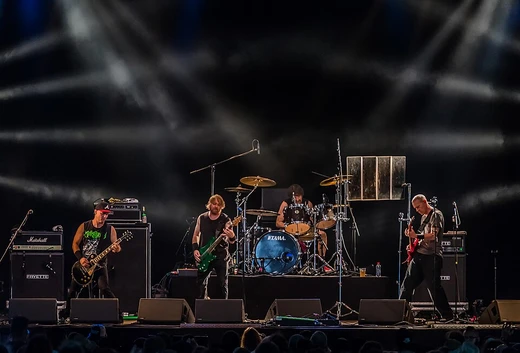
Helmet (band)
American alternative metal band formed in 1989 by Page Hamilton.

Helmet is an American alternative metal band formed in New York City in 1989 by singer and lead guitarist Page Hamilton. The group has seen many lineup shifts, with Hamilton remaining the sole original member. Since 2010, the band has featured Hamilton, drummer Kyle Stevenson, guitarist Dan Beeman, and bassist Dave Case.
The band has put out nine studio albums and two compilations. Their first album, *Strap It On* (1990), came out on Amphetamine Reptile, after which they signed with Interscope Records and released three albums there, starting with the hugely successful *Meantime* (1992). The follow-ups *Betty* (1994) and *Aftertaste* (1997) also did well but didn’t reach the same critical or commercial heights as *Meantime*. Helmet split up in 1998 after a final tour that year, got back together in 2004, and have since released five more albums: *Size Matters* (2004), *Monochrome* (2006), *Seeing Eye Dog* (2010), *Dead to the World* (2016), and their most recent, *Left* (2023).
Hamilton started the band in early 1989 after leaving the alternative rock group Band of Susans, where he had played on two records. Originally from Oregon, he had moved to New York to study jazz guitar at the Manhattan School of Music. He recruited bassist Henry Bogdan (also from Oregon), Australian guitarist Peter Mengede, and Florida-born drummer John Stanier as the first official lineup. Before settling on a name, Mengede’s then-wife Reyne Cuccuro suggested the Germanic name “Helmuth.” Hamilton misheard her, thinking she meant the protective headgear, and liked the idea, going with the English spelling. Other names considered included “Cry Ruth,” “Poly Orchids,” “Tuna Lorenzo,” and “Froth Albumen.”
The band was spotted by Tom Hazelmyer, guitarist of Halo of Flies, and signed to his label Amphetamine Reptile Records. Their first 7-inch single, “Born Annoying,” came out later that year (released as part of an album in 1995). Their debut album *Strap It On* arrived in 1990 and sold over 40,000 copies soon after. Hazelmyer later said the album kept his label afloat through the 1990s.
Though *Strap It On* found local success, major labels showed no interest until Nirvana broke through in 1991, bringing alternative music into the mainstream. After that, Helmet got offers from Relativity, Warner Bros., and Interscope. In January 1992, they signed with Interscope for a $1.2 million ad
- years_active
- 1989–1998, 2004–present
Lore & Background
Helmet was formed in early 1989 after Page Hamilton left the alternative rock group Band of Susans. The original lineup included bassist Henry Bogdan, guitarist Peter Mengede, and drummer John Stanier. The band's name originated from a misinterpretation of the Germanic name 'Helmuth' suggested by Mengede's then-wife. They signed to Amphetamine Reptile Records and released their debut album Strap It On in 1990, which sold over 40,000 copies. In 1992, Helmet signed to Interscope Records for a $1.2 million advance and released Meantime, which was certified gold in 1994 and sold over two million copies worldwide. Internal tensions led to lineup changes, including the departure of Mengede in 1993 and later Echeverria in 1995. The band broke up in 1998 after a final tour that year, with their last show occurring in 1998.
Reader's Guide
Helmet's significance lies in their role in the alternative metal scene of the 1990s, particularly through their landmark album Meantime, which brought them mainstream success and influenced many later bands. Their sound, characterized by heavy, rhythmic guitar work and Hamilton's distinctive vocals, helped define the genre. Despite numerous lineup changes and a breakup in 1998, the band's continued output under Hamilton has maintained a dedicated following. Their legacy includes a gold-certified album, extensive touring, and a reputation for internal tension that ultimately led to their original dissolution. The band's ability to reform and continue releasing music demonstrates their enduring appeal within the alternative metal community.
Did You Know?
- The band's name originated from a misinterpretation of the Germanic name 'Helmuth'.
- Helmet's debut album Strap It On kept Amphetamine Reptile Records going through the 1990s.
- Helmet collaborated with House of Pain on the song 'Just Another Victim' for the Judgment Night soundtrack.
- Page Hamilton played guitar for David Bowie after Helmet's initial breakup.
The Accidental Name and a Band Born in Manhattan
Page Hamilton had originally come to New York City to study jazz guitar at the Manhattan School of Music, but in early 1989 he channeled that energy into something louder. After departing the alternative rock group Band of Susans, where he had recorded two albums, the Oregon-born guitarist assembled a diverse roster: fellow Oregonian Henry Bogdan on bass, Australian Peter Mengede on guitar, and Floridian John Stanier behind the drums. The band's name arrived almost by accident. Mengede's then-wife Reyne Cuccuro suggested the Germanic word 'Helmuth,' but Hamilton misinterpreted the suggestion as a reference to protective headgear. He immediately latched onto 'Helmet' as a cool-sounding option, passing over alternatives like 'Cry Ruth,' 'Poly Orchids,' 'Tuna Lorenzo,' and 'Froth Albumen.' Guitarist Tom Hazelmyer of Halo of Flies spotted the group and signed them to his Amphetamine Reptile label. Their debut, Strap It On (1990), moved over forty thousand copies, and Hazelmyer later credited that record with keeping the label afloat throughout the 1990s.
The Interscope Deal and the Meantime Era
Helmet's local buzz with Strap It On went largely unnoticed by major labels until Nirvana's 1991 breakthrough pulled the alternative scene into the mainstream. Offers then poured in from Relativity, Warner Bros., and Interscope. In January 1992 the band chose Interscope, securing a $1.2 million advance spread across three records, $50,000 in tour support, and an unprecedented degree of creative control. Meantime (1992) became a defining moment: certified gold by 1994 and eventually selling over two million copies worldwide, it remains the band's best-selling record. Helmet toured the United States, Brazil, Europe, and Asia with relentless intensity, often sharing bills with fellow Amphetamine Reptile artists. Yet pressure mounted. In early 1993, Mengede departed over a contractual dispute and later joined the supergroup Handsome. Rob Echeverria of Rest in Pieces stepped in, and the band contributed 'Just Another Victim' alongside House of Pain for the Judgment Night soundtrack. Betty (1994) reached number 45 on the Billboard 200—Helmet's highest chart position—though sales fell short of Meantime. Echeverria then left amicably for Biohazard, and the band pressed forward as a three-piece into the late 1990s.
A Decade Apart: Breakup and Parallel Lives
Long-standing private disputes finally brought the run to an end. Helmet's last performance before the split took place in Italy on December 10, 1997, and the band officially dissolved in November 1998. Reflecting on the decision, Hamilton summed it up bluntly: '9 years, 1,600 shows, 5 albums, and we found it hard to look at each other anymore.' The members scattered into separate musical lives. Bogdan formed the Moonlighters in New York with Bliss Blood, playing steel guitar, before eventually returning to Oregon to perform with the Midnight Serenaders. Stanier stepped away from drumming for a period but re-emerged behind the kits of Tomahawk, The Mark of Cain, Battles, and Primer 55. Hamilton, meanwhile, relocated to Los Angeles and immersed himself in a wide range of projects. He played guitar for David Bowie, contributed to film scores, and collaborated with composer Elliot Goldenthal on the soundtracks for In Dreams (1999) and Titus—his second partnership with Goldenthal after the 1995 Heat score. He also participated in a collective of guitarists dubbed 'Deaf Elk.' Periodically he returned to New York to work with his band Gandhi, where several songs that would later appear on Helmet's Size Matters first took shape.
Reunion and the Long Tail of New Albums
In August 2003, Hamilton began assembling a new musical project with guitarist Chris Traynor—whom he had recruited for the Aftertaste tour—and drummer John Tempesta, known for his work with Testament and White Zombie. Around the same time, Interscope announced a greatest-hits compilation for the band. Helmet reformed in 2004 and released Size Matters that year, drawing on material that had germinated during Hamilton's Gandhi sessions. Monochrome followed in 2006. After a four-year gap, Seeing Eye Dog arrived in 2010, marking a new era with the current lineup: Hamilton on vocals and guitar, Kyle Stevenson on drums, Dan Beeman on guitar, and Dave Case on bass. That configuration has endured to the present day. Dead to the World came in 2016, and Left followed in 2023, bringing Helmet's studio catalog to nine albums alongside two compilations. Throughout every iteration and personnel shift, Hamilton has remained the sole constant member, the creative anchor around which the band's identity has consistently reformed.
Frequently Asked Questions
Who is Helmet (band)?
Helmet is an American alternative metal band that got its start in New York City in 1989. They were put together by singer and lead guitarist Page Hamilton, who has remained the only original member through every lineup change since.
What is Helmet's most famous album?
Their 1992 record *Meantime*, released on Interscope Records, is widely considered their breakthrough and most celebrated work. It followed their 1990 debut *Strap It On* on Amphetamine Reptile and cemented the band's reputation in the alternative metal scene.
Who is the constant member of Helmet?
Page Hamilton, the group's vocalist and lead guitarist, is the sole original member who has stayed with the band from 1989 to the present. Since 2010 the lineup has included drummer Kyle Stevenson, guitarist Dan Beeman, and bassist Dave Case alongside Hamilton.
Why did Helmet take a long break and when did they come back?
The band stopped recording and performing after 1998 and did not reunite until 2004, leaving roughly a six-year gap in their activity. Their official active periods are 1989–1998 and 2004–present, and they have continued releasing material since the reunion.
How many studio albums has Helmet released?
Helmet has put out nine studio albums and two compilations over the course of their career. Their discography stretches from the 1990 debut *Strap It On* through later records issued after their 2004 return.
More in American post-metal musical groups 1-24
Spotted an error? Know more?
This is a living reference — every entry is fact-audited, and reader corrections feed straight into our audit queue. Suggest an edit · See this site's audit record