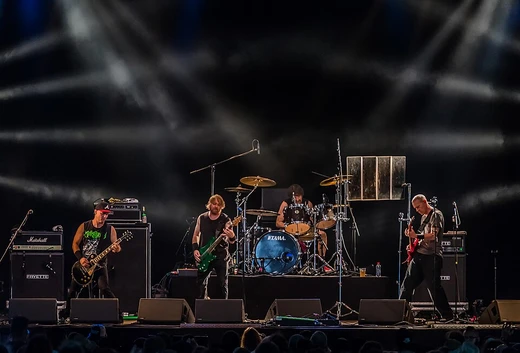
Deafheaven
American blackgaze band formed in 2010 in San Francisco.

Deafheaven, an American band that blends black metal with shoegaze and post-rock, came together in 2010. The group started as a duo in San Francisco, featuring vocalist George Clarke and guitarist Kerry McCoy, who had previously played together in the grindcore band Rise of Caligula. They recorded and self-released a demo in April 2010 at Atomic Garden Studios with Jack Shirley, spending about $500 they couldn't afford. Since they lacked an electric guitar and amp, the demo was written on an acoustic guitar and recorded with borrowed studio equipment. The untitled demo, released digitally and on limited cassette tapes, contained four songs fusing traditional black metal with post-rock. Initially not intended for release, the duo sent it to a few favorite blogs; after positive reception, they recruited bassist Derek Prine, guitarist Nick Bassett (from the shoegaze band Whirr), and drummer Trevor Deschryver (who answered a Craigslist ad) to form a five-piece, playing their first shows in July 2010.
In December 2010, Deafheaven signed to Deathwish Inc., a label founded by Converge vocalist Jacob Bannon. Deathwish had initially contacted the band to give the demo a wide physical release, but the group had new material ready and asked if both could be released. Their first Deathwish release was a limited 7" vinyl single featuring "Libertine Dissolves" and "Daedalus" from the demo, sent as a gift to random webstore customers. Their debut album, *Roads to Judah*, came out on April 26, 2011, through Deathwish. The title references the N Judah light rail in San Francisco, and the lyrics deal with Clarke's year of substance abuse. The album earned positive reviews from outlets like *Decibel* and RVA Magazine, appeared on year-end lists from NPR, Pitchfork, and *The A.V. Club*, and MSN Music named Deafheaven one of the best new artists of 2011. To promote it, the band played SXSW in March 2011, toured the US with KEN mode in June, performed at California's Sound and Fury Festival in July, toured with Russian Circles in November, and did a European tour in February 2012. McCoy said Russian Circles taught them that successful bands write good tunes, are excellent live, and don't act like assholes. Deafheaven also played Northside and Fun Fun Fun festivals in mid-2012. As part of Deathwish's free live album series, they released *Live at The Blacktop* in July 2011, featu
- formed
- 2010
- origin
- San Francisco, California, United States
- genre
- Blackgaze
- nationality
- American
- label
- Deathwish Inc.
- known_for
- Blending black metal, shoegaze, and post-rock
Lore & Background
Deafheaven formed in February 2010 in San Francisco with vocalist George Clarke and guitarist Kerry McCoy, who previously performed in the grindcore band Rise of Caligula together. The name Deafheaven is a combination of 'deaf' and 'heaven' as a homage to Slowdive, and Clarke is aware of its appearance in William Shakespeare's Sonnet 29. They recorded an untitled demo in April 2010 at Atomic Garden Studios with Jack Shirley for about US$500, which the band could not afford at the time. The demo was written on an acoustic guitar and recorded with borrowed equipment. After positive reception, they recruited bassist Derek Prine, guitarist Nick Bassett, and drummer Trevor Deschryver to form a five-piece group, playing their first shows in July 2010.
In December 2010, Deafheaven signed to Deathwish Inc., a label founded by Converge's vocalist Jacob Bannon. Their debut album, Roads to Judah, was released on April 26, 2011, through Deathwish. The title references the N Judah light rail in San Francisco, and lyrically the album is about Clarke's 'year of substance abuse and debauchery.' The album received positive reviews and was placed on several year-end lists. The band toured extensively, including with Russian Circles, who taught them that the three rules of any successful band are to write good tunes, be excellent live, and not be an asshole.
Sunbather, released June 11, 2013, was critically acclaimed, with Metacritic rating it 92/100 and declaring it the best-reviewed major album of 2013. It was Deafheaven's first release to chart on Billboard. The band's lineup changed, with new drummer Daniel Tracy joining for the recording, and bassist Stephen Clark and guitarist Shiv Mehra recruited for tours. Subsequent albums include New Bermuda (2015), Ordinary Corrupt Human Love (2018), Infinite Granite (2021), which drastically reduced black metal elements, and Lonely People with Power (2025), which featured a return to their aggressive blackgaze sound.
Reader's Guide
Deafheaven's significance lies in their role in popularizing the blackgaze genre, a fusion of black metal, shoegaze, and post-rock. Their 2013 album Sunbather received widespread critical acclaim and was named the best-reviewed major album of 2013 by Metacritic, bringing the genre to a broader audience. The band's evolution is notable: from the raw black metal-influenced demo and Roads to Judah, through the lush, rock-driven sound of Sunbather, to the more experimental New Bermuda and Ordinary Corrupt Human Love. Their 2021 album Infinite Granite marked a drastic shift away from black metal toward a primarily shoegaze sound with clean vocals, while 2025's Lonely People with Power returned to their aggressive blackgaze roots. Deafheaven's legacy includes influencing a wave of bands blending extreme metal with ethereal, atmospheric elements, and their work has been consistently featured on year-end lists and critical roundups. Their tours with acts like Russian Circles and Between the Buried and Me helped solidify their place in the broader heavy music landscape.
Did You Know?
- The name Deafheaven combines 'deaf' and 'heaven' as a homage to the band Slowdive.
- Their debut demo was recorded for about US$500, which the band could not afford at the time.
- Sunbather was declared the best-reviewed major album of 2013 by Metacritic.
- The title Roads to Judah references the N Judah light rail in San Francisco.
Origins: A Two-Piece and a Borrowed Guitar
Deafheaven began in February 2010 when vocalist George Clarke and guitarist Kerry McCoy—former members of the grindcore project Rise of Caligula—decided to record together in San Francisco. The name carries a double resonance: Clarke recalls it appearing in Shakespeare's Sonnet 29, while the pairing of "deaf" and "heaven" was a deliberate nod to the shoegaze band Slowdive. Their first output was an untitled four-track demo recorded in April 2010 at Atomic Garden Studios with engineer Jack Shirley, costing roughly five hundred dollars. Neither musician owned an electric guitar or amplifier, so the songs were written on acoustic guitar and captured with borrowed studio gear. The duo initially had no plans to release the material but, after sending it to a handful of blogs and receiving warm responses, they expanded to a five-piece by adding bassist Derek Prine, guitarist Nick Bassett of the shoegaze group Whirr, and drummer Trevor Deschryver, who answered a Craigslist ad. Their first live shows came in July 2010.
Deathwish, the Debut, and Learning the Road
By December 2010, Deathwish Inc.—the label founded by Converge frontman Jacob Bannon—had reached out to the band. What began as a simple offer to physically release their demo grew into a full partnership once Deafheaven revealed they already had new material in hand. Their first Deathwish release was a limited 7-inch vinyl pairing "Libertine Dissolves" and "Daedalus," pressed in small numbers and mailed as a surprise gift to customers of the label's webstore. The debut album Roads to Judah followed on April 26, 2011. The title nods to the N Judah light rail line running through the band's home city, while lyrically the record documents Clarke's self-described "year of substance abuse and debauchery." Critics at Decibel, RVA Magazine, NPR, Pitchfork, and The A.V. Club all took notice, and MSN Music named Deafheaven one of the best new artists of 2011. On the road, touring with post-rock group Russian Circles proved formative; McCoy later credited them with hammering home the fundamentals of professional band behavior.
Sunbather: Perfection as a Wound
Sunbather, released in 2013, marked a decisive shift in the band's creative process. Unlike Roads to Judah, which was composed as a five-piece, the new record was written solely by Clarke and McCoy, echoing the collaborative method behind their original demo. In the studio they were joined by new drummer Daniel Tracy, who layered his own rhythmic sensibility onto song structures the duo had already built. Clarke described the material as less melancholic and less anchored in black metal, leaning instead toward a lush, rock-driven, even pop-driven palette. The title, he explained, evokes a wealthy, beautiful, perfect existence that is inherently unattainable—and the daily struggle of confronting that gap against one's own faults, relationship troubles, family issues, and mortality. The album was met with wide critical acclaim in the United States, landing on numerous best-of-2013 lists and cementing Deafheaven's reputation as a defining voice in the blackgaze movement that reviewers had begun to name.
A Sound in Constant Motion
After Sunbather's success, Deafheaven continued to evolve their palette with each subsequent record. New Bermuda arrived in 2015, followed by Ordinary Corrupt Human Love in 2018, each refining the blend of black metal, shoegaze, and post-rock that critics had coined "blackgaze." The most dramatic pivot came with 2021's Infinite Granite, which drastically curtailed the band's black-metal elements in favor of a predominantly shoegaze texture, with Clarke singing mostly clean rather than shrieking. The album signaled a willingness to strip away aggression and let atmospheric guitar work take center stage. Yet Deafheaven proved they could return to their roots just as readily: 2025's Lonely People with Power brought back the aggressive, high-contrast blackgaze sound that had defined their earlier work. Across fifteen years, the band has demonstrated a consistent refusal to settle, moving between raw black-metal fury and hushed, reverb-drenched beauty while maintaining the core partnership between Clarke and McCoy as the creative engine.
Frequently Asked Questions
Who is Deafheaven?
Deafheaven is an American band from San Francisco that fuses the raw intensity of black metal with the ethereal, layered soundscapes of shoegaze and post-rock. They are widely recognized as a defining act in the blackgaze subgenre.
What genre does Deafheaven play?
The band is most closely associated with blackgaze, a style that marries black metal's tremolo-picked aggression and harsh vocals with the hazy, reverb-soaked textures borrowed from shoegaze and post-rock.
When and where was Deafheaven formed?
Deafheaven came together in 2010 in San Francisco, California, beginning as a two-person project before expanding into a full band.
Who are the founding members of Deafheaven?
Vocalist George Clarke and guitarist Kerry McCoy started the band after previously playing together in the grindcore group Rise of Caligula.
What record label is Deafheaven signed to?
Deafheaven releases their music through Deathwish Inc.
More in American post-metal musical groups 1-24
Spotted an error? Know more?
This is a living reference — every entry is fact-audited, and reader corrections feed straight into our audit queue. Suggest an edit · See this site's audit record